boyangforwei09@gmail.com

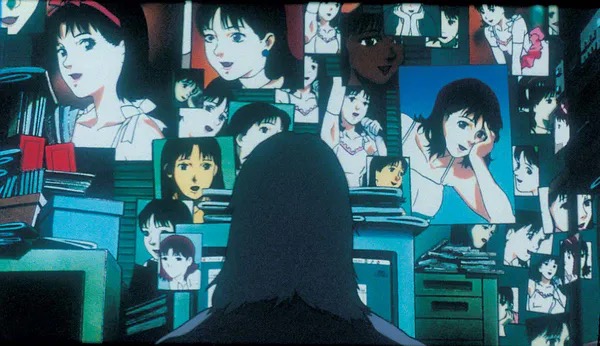
  • Perfect Blue

    很多作者的处女作里都会有的一个误区是认为人物的被描述价值必须体现在他们在场景里的姿态和整体叙事进程所实现的“沟通”。但得益于动画形式的特殊性,场景在其中的构象可以直观上更加丰厚,于是各类荒诞的畸变在快速变换中仍被希望受到具体的沟通性逻辑串接反而成为了一个“正确”的意图。

    ——

    It has become almost a common mistake for many up-and-coming filmmakers to consider their characters’ descriptive value as univocally measured by the communicative attribute of those individual gestures – in their respective scenes – that answer the film’s narrative arc. Yet, given the formal latitude of the anime genre, its configural capacity represents a degree of material variety far exceeding that in real shooting. The visual motifs in animated works are consequently easy to render iconographically excessive, in which, though admirable for imagination’s sake, few are scrupulously developed, and a major aspect of their value lies in warming up for spectacles “next to now”,  and therefore making themselves lightheartedly obliterated when the subsequent attraction arrives, as always promised.

    In this respect, the most contradictory thing is that the imagination itself is so obsessive that nothing related to its concrete object should be treated seriously. Perhaps not coincidentally, the original mistake that overdetermines the synchronization between individual exertion and macroscopic trajectory is now a somewhat necessary intention, insofar as its concern for synecdochical dialogue counterbalances the addiction to pursuing the high-flown visibility under animation discourse.

    —— 2024.06.27
  • Fireworks

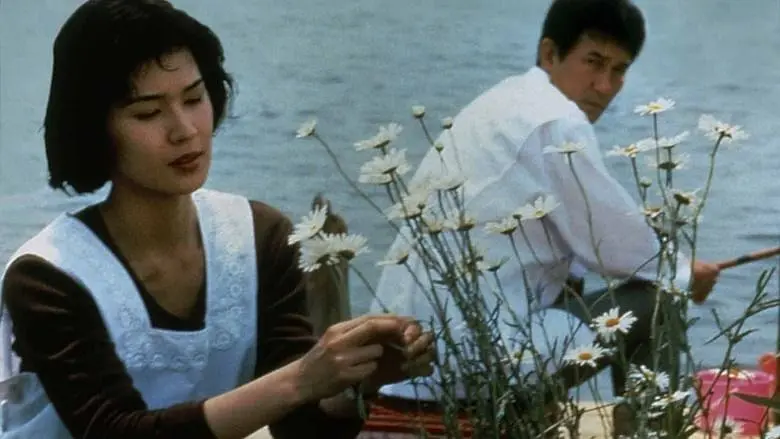
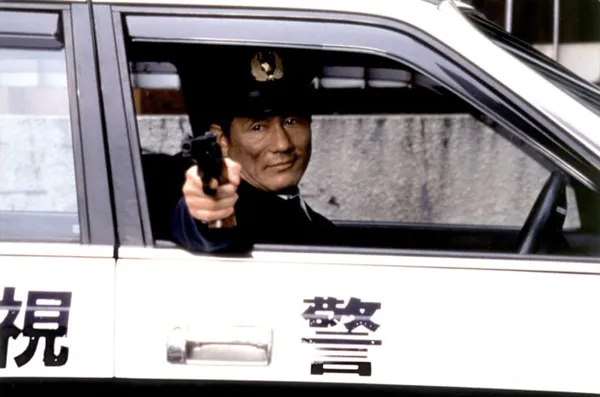
    《花火》里依然存在北野武的游戏时间,充满破坏欲但又充盈着静谧,其中危机的运动永远消融在安逸的轮廓里。值得注意的是那些后拉的摇镜,逐渐呈现全景,由此在面或体中出现了“点”的入口——暗示“注视”发生在别处。尾声在四人场景中放入两颗子弹,镜头摇向大海,收于风筝女孩的目光中。摄影机“凝视”的客体发生变化,先前所有被凝视的死亡重新出现,两种状态间出现了关于“认同”的联系;生者与尸体间,那里有一段明媚的距离。

    ——

    Kitano has a flair for making his image (qua movement) full of destructive play while maintaining every precarious process within a larger picture indicative of serenity. The tension generated by the procedural hazards of those gory moves is always defused by the cavalier nonchalance that pervades the situation.

    I also noticed those pull-back shots in the film, which reveal the particular entrance in a plane by gradually disclosing its full landscape with an angular zoom-out. And by visually drawing out the extension of close violence, the camera succeeds in indicating the faculty of incarnated gaze as always held “elsewhere”. In the closing sequence of Fireworks, so to speak, when two bullets streak across the seaside scene featuring four figures, the camera then pans towards the sea, tapering into the innocent sight of the kite-flying girl. As the scene progresses, the protagonist bearing the camera’s gaze keeps shifting; the aligned contemplation recalls all previous deaths that occupy the same position, thereby bringing in a mutual identification that coalesces the live and the dead into one subject able to reflect both the camera’s empathic look and Kitano’s satirical fanaticism of romanticizing bloodshed while not veneering the brutal consequence of those acts ruining the somatic texture. 

    Another thing Kitano tells his audience is that killing does not have to be radically gruesome; the distance between life and death can be as bright as from the seashore to the ethereal horizon.

    —— 2021.10.22

  • Starship Troopers

    范霍文的叙事方法值得被电影理论学进一步深挖。他对于关系体量的状态调控有着类似于古典作者们的均匀,即对于他的影像,观看者能够感受到并不严格受限于场景形态所形成的若干区间。但不同的地方在于,对于进程里的每一个时刻,他似乎都附着有一个隐性的增势(即对于该点进程曲线的求导导数大于零)。如果在这里寻求其原理,可能是他既不一定追求被引入的材料群存在绝对的意指,却也避免它们成为逻辑给定的需求意指,所以他的新纳入的关系结构具备较好的呈递性又保持了一个(似乎)得到扩展的运动群体,促进了观看者对事件进程的感知。

    ——

    I believe Paul Verhoeven’s narrative strategy can provide a wealth of insights for film theory studies. His qualitative maneuvering in cinematic relationship buildup seems to proceed from a classical aura where there is always a sense of “patient curiosity” presiding over things’ meandering. Rewardingly, the viewer who ensconces themselves as his audience can often discern in his work variegated sections unfettered by scene-supported development. 

    Yet, distinguished from old-time slow-burn narrations, Verhoeven is used to attaching, or more strategically, appending a potential uptick to every one of the foreshadowing moments in his drama-building. The tensions slyly accumulated on set scarcely promise an escalating outburst endemic to most commercial releases as a provisional stage mark. Still, these very tensions represent an arousing tendency, but they function hardly more than that; a subtle tendency, graphically resembling a mild curve whose tt-moment derivative gives a slightly positive value.

    It seems hesitant to trace the director’s motivation and explicate how he has accomplished so. But since he has already achieved this, the capacity of newly added elements becomes fully optimized. Now, as in the signifying chain of Starship Troopers, the recurring slender modulation acting upon the film’s level of tension prevents the signified triggered by any recently joined object from stooping to either generic usage or the dry demands of narrative logic. The semantic conditions formed before and after material expansion are therefore cohesively and convincingly connected; meanwhile, a heightened circumstance has been absorbed into the film’s ongoing progression, still assuring the audience that the sequence is moving.

    —— 2024.03.02

  • The River

    对称关系生成激情:它产生的是一种现象和谐,其中的素材相似性带来了联想的合并(联想材料是从影像材料或材料之间再复合中获得)。《河流》中我们常自发将两个主体放置在一起研究其对外作用与内力逻辑,而蔡明亮恰恰通过维护这种自发揭示了这一过程里的暧昧性,这一思路接近物理中的质点组模型。

    ——

    I do not usually consider Tsai Ming-liang’s films that possess very much esoteric intuition or arcane spirits. But I’ve learnt his notable use of symmetry from The River, an idiosyncratic exercise in making proportioned subjects generate cinematic passion through their asynchronous presence.

    A symmetrical structure can organize phenomena primarily in terms of harmony, since the similarity between groupings catalyzes the reflective dimension of those hallmarks when they appear as one half of the structure. The elements currently present, if included in the comparison process, serve as anchors for a larger pairing, whose counterpart is supplied by other corresponding configurations that occupy their own moment in view, and whose integration relies on the viewer’s simultaneous apprehension of certain distinct moments. Therein, the substance enabling this identification can be provided by either a direct image or the mental reconstruction through accumulated reminiscence.

    In The River, characteristic subjects are captured separately by the camera, but their states remain correlated whenever one of them is physically present on screen. There is an automatic consciousness that prompts us to coalesce their existences into an entity, on the surface of which forces counteract one another, and dynamism is transferred in between; inwardly, we nevertheless focus our interpretations on their private interactions and no longer concern ourselves with external conditions. 

    Certainly, in theory the number of such groupings can be arbitrary. And Tsai Ming-liang has settled it on two in The River. He shows that once the elements in the dyad have formed between the two sets an enduring bond as ideal a model of particle physics as letting one presume their wholeness, a sense of romance is bound to emerge.

    —— 2022.01.18

  • Made in Hong Kong

    重拾了香港影像的节律——形体在潮湿的大厦间的廊道里奔跑,在行径间隙的狭短光瀑里惊鸿一瞥身下世间,想象竭尽的灿烂里风干的繁华,然后个体迫于惯性又必须经历所念景观瞬息的凋亡。附着于先置运动的影像在若干“截断”中被编织。其它世界电影里很难再找到类似特征的地域成像。大陆的一些作品或许曾接近,但其中日光的持续往往更漫长。

    ——


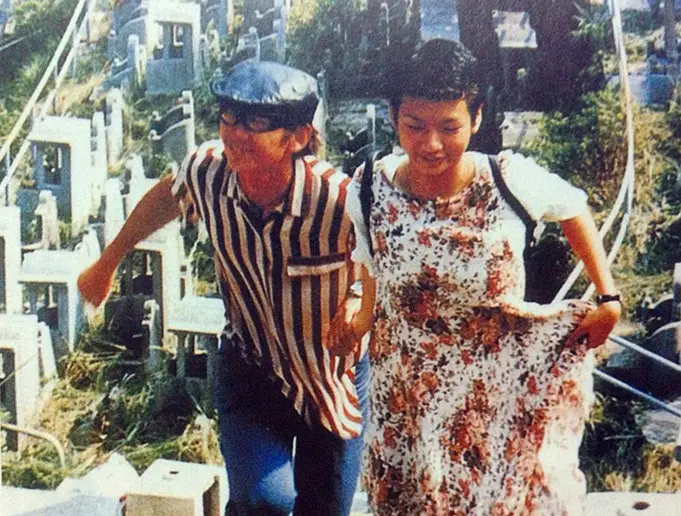
    After a long absence of Hong Kong films on my watchlist, Made in Hong Kong has replenished my perception with the region’s endemic aesthetic rhythm.

    In general, HK films released around the end of the second millennium always evoke a highly graphic image in my mind, and Chen Kuo has taken this tendency to an extreme. The image resembles a moving vignette, roughly revealing an entrapped figure running in the messy corridors of those massive, damp buildings. There is sunlight sporadically projecting its beam upon the figure’s front, an evanescent instant yet effulgent enough to illuminate the world beneath him when he dashes through. And every time he glimpses outward within the sunfall while running, streets look incandescent against the blue window’s suspended steel. And every time he refocuses on the cloudy window standing as one of many, the world and the light are gone. He returns to the afterworld that consists of dingy corridors. He resorts to imagining what has passed. He had begun this many times, and he never stops running. As such, without knowing permanence and destination, without knowing that a destination is just a treacherous measure of permanence, the fleeting prosperity, with all the sweat therein, always comes to sustain the end of his imagination, accompanied by the eidetic sunshine, the visceral sunshine, the breathless sunshine, the sunshine shining for death.

    The HK films associated with that time used to design each of the glaring transiences as the epoché moments between which there was inundating desperation and anxiety. Interestingly, although many regions nowadays have had a surfeit of architecture, it’s almost impossible for me to regain the commensurate illusion from the rest of world cinema. Perhaps a few mainland Chinese images have ever conjured a similar figure in motion, but the sunfalls therein were much more lingering, and we’ve had a vision.

    —— 2025.07.26

  • Unagi

    如果今村昌平不把那场发廊闹事当作小高潮来处理的话,尾声可能会更流畅些,往后明显能感到他开始规划各类收束,出现语气的断层。“鳗鱼”其实是一个良好的切点,连通切点的水缸,池塘都是良好的发生装置,但今村所执行的,一直是语气和客体行为的同质,他描述的荒诞现象统一可被理解成心境的具象载体;而始终不能像寺山修司这样的作者再进一步,将那些光怪陆离作为现实的补完(两类作者的创作逻辑就如同探究原材料和选择生成物的描述词的关系一般,前者具有更强的延伸性,后者使得环境被描述得更加严谨)。

    ——

    There would be a more convincing ending if Shohei Imamura had avoided overdramatizing the chaos brought to the hair shop scene. After this incident, his deliberate intent to conclude the previously established relationships becomes apparent, resulting in an abrupt shift in tone. 

    Semiotically, unagi can be a fairly effective signifier, whose linguistic pairing between material and reference is so specific that one can easily infer the newly circumscribed signification from the object’s unusual associations in the film. The water tank and pond containing unagi are, in addition,  determinate systems capable of repeatedly displaying reflections in unagi’s constant yet portentous swimming. 

    However, Imamura has always sought to keep narrative tone and character behavior tightly synchronized, almost in idealist terms, so that the droll phenomena he depicts in Unagi appear largely tied to outward links from the narrator’s spiritual form. This representation mode is distinct from another Japanese theatrical school, in which, as in the works of Shūji Terayama, grotesque beings are a contemplative source complementary to the material logic of reality.

    In a linguistic sense, there is also a practical way to compare the two styles:  What Shūji primarily concerns himself with is often the operative possibility of an unfamiliar view carrying the primordial substance of the world, while Shohei, on the other hand, focuses on the modificative value of the already ascertained ground, which might achieve a more articulate phase yet at the expense of things’ virginity.

    —— 2021.09.27

  • Boogie Nights

    相较于PTA后来的作品, 《不羁夜》最出色的并不是有关空间技法的展示,而是对各项艺术手段在特定语境下的同质性的捕捉。导演似乎只是在描述一类统一,关于人物的不谋而合,从中共同垮掉在霓虹与风月。甚至没有一个细节的入口可以延展到行业的解构,或是角色天赋的自反。镜头里永远是不羁夜下的狂欢亦或起舞,这或许是最好的追忆方法,引导出特定时代里安逸的永恒。

    ——

    With the benefit of hindsight, as we compare Boogie Nights to PTA’s later works regarding their respective singularity, the camera’s traveling within space for this one is less mesmerizing than its photographic extraction of a coherent expression from a wide range of art-related media when they converge under a given circumstance. 

    In this respect, PTA apparently concerns zeitgeist union as the sine qua non of retrieving a period’s essence. In Boogie Nights, there are characters unconsciously sharing the same belief, and there were days and nights evanescent from their remembrance. The flow of mass spirits is indifferent to its backline, and there was unwitting diffusion too desultory to generate any reflection. A political analysis would fail if one seeks to deconstruct the provided society through the film’s trivial depiction, much like a character study that aims to trace identity and talents. Instead, the visual intelligence has been gradually spoiled by the film’s “meretricious” merrymaking, which PTA uses to conduct the sumptuous recollection of his lost age. The textual aspiration may appear tendentious and frivolous in a certain sense; paradoxically, yet not without reason, it substantially preserves the filmmaker’s nostalgic sensibility by committing to the time’s perennial engagements rather than emphasizing its shifts.

    —— 2021.10.31

  • The Lovers from the North Pole

    非常有趣的观影体验,自己的感官系统如同被覆膜,然后置于冰寒的雪地间。我看到每段事件,看到其中常规的交互,却又深谙自己存在先天的限制,难以成全纯粹的接触。这片地域,在内部的作息之中永远附着着一层来自环境的温度,如同植根宇观之中的本性。如若被人物的经历打动,反抗着击碎那层薄膜,渴望共情,便会感受到扑面而来的清冷与深寂。同时,这部电影值得称赞的一处是它将反复强调的两个概念(circle,coin)的关系(后者通常是之于前者的先验)具化在两个实体的逻辑中。比如Anna将意识对准天空,那么Otto则是去努力兑现一场翱翔的实践。女孩打开一脉天地,布留一些现象。男孩便尝试去分析运行方式,解释所有映射。在Otto/Anna往复交措的叙述结构中,其实是经验与直觉在面对幽秘时空时的成立与补完。

    ——

    I had gained the experientially attuned watching with this work, as though my own sensing had undergone a glacial penetration. With each scene, as the earthbound dialogue unfolds, I become further removed from contemplating the texture of speech itself. Instead, there is always a pensive tide flowing backward from the Northern European landscape into its domestic solitude: an enveloping natural world whose bleakness obscures the very accountability of the viewer’s relating..

    The persistent pairing of the “circle” and the “coin” finds one of its most striking cinematic expressions in The Lovers through two embodied figures. Anna comes to manifest the Coin, while Otto gradually assumes the position of the Circle. Throughout the film, it is the girl who first establishes a ground, depositing within it an inscrutable residue of phenomena; the boy, in turn, painstakingly interprets the hidden reflections that gather around her gestures. Through the repeated interplay of the two’s complementary roles, empirical observation and intuition become inseparable, as the land’s mystical environment reveals itself around every presence.

    —— 2022.04.30

  • Rushmore

    韦斯安德森青春电影的准确性在于他可以从人物的稚气中提炼出与之相契合的庄重逻辑。客观上不成熟的描述条件于是也可以获得经历层面“充分的复杂”。类似的认知放缩在有些场景下可以被赋予关于“叛逆”的语气,即人物对彼此行为做出的反应具有着理由的辩证性;阻隔和纵容分别的效果发展只取决于视角暂时的附着对象。反问和陈述就在两类错位的”正当“中持续进行。

    ——

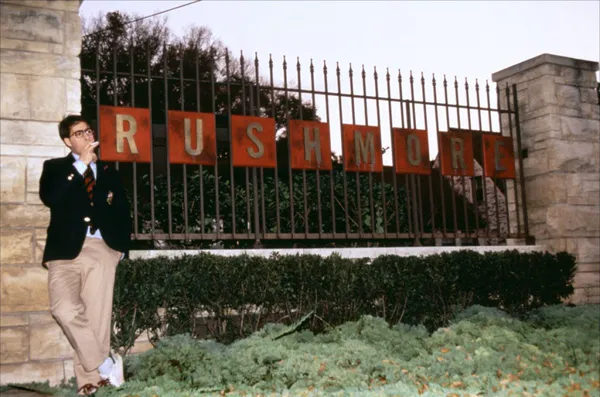
    One of Anderson’s storytelling prowess is his making of seriousness that is always commensurate with the abundance of the host’s lived experience. Regardless of maturity, a character’s mindset becomes intelligibly free of charge and can demonstrate their own rigor as warranted and complex as one’s becoming. The scale-varied sensibilities are often ready to carry a certain recalcitrant tone when circumstance calls for diplomats, where characters divided by perspective all have sufficient professions to play repartee. Whether the subsequent voice chooses to sustain or look beyond one of their defensible expressions depends entirely on which team’s stance offers more momentary comfort. To question and to state are undertaken in alternation across a variety of validity.

    —— 2026.07.19

  • Bullet Ballet

    如果将影像中人物身体性运动进行分类,那么它可以被分成负责维系事件内部关系建构的“身体运行”与负责事件外部关系建构的“身体舞蹈”。这部作品可以作为一个非常典型的案例,用于说明在针对一个明确的,长期的事件叙述里加入“舞蹈动作”并不能使得身体运动的实质发生改变。它造成的结果只是让人物运作舞姿,而不能使人物真正在某一段时期成为舞者。这和观看者习得一段语境后在和影像内容建立关系时自发的意识倾向有关,所以说“事件之外”其实代表着原始语境被短暂地覆盖,它是主梢的枝桠或是两条长路之间的小径。

    ——

    If we categorize the body according to its function within filmic movement, it can be divided into two modes. First, there is the operative body, which functions within the internal relations of the event itself. Second, there is the body as spectacle: a complete, self-contained display shaped by forces external to the central action.

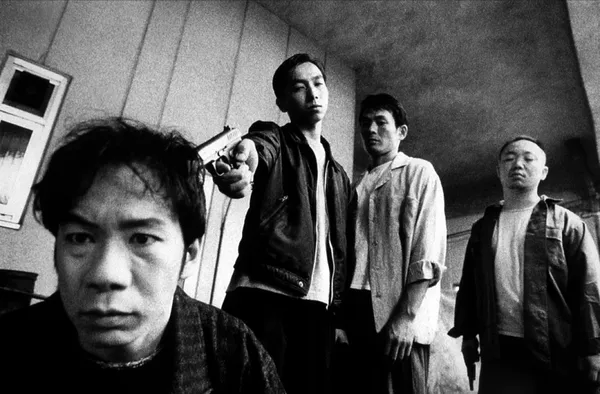
    With regard to the “location” in which the body presents its instrumental physicality, this film exemplifies how the persistent insertion of statuary body into the unfolding of the plot contributes little to discursive development. Rather than leading the spectator to identify the body as the product of training or transformation, the film’s repeated emphasis on bodily display instead burdens its visual field. Its connection to the narrative becomes contingent upon the spectator’s own investment in its material articulation.

    As a result, foregrounding the body as substance – highlighting its exhibitive potential – inevitably dilutes the immediacy of the film’s discursive direction. Yet this strategy cannot, on its own, determine the trajectory through which signs come to signify the happening.

    —— 2024.06.15